Hydraulic Oil Buffer for High-Speed Elevators, Carbon Steel/Stainless Steel, 150mm–600mm Stroke, Red/Yellow, CE/ISO, Crash Protection & Noise Reduction
Introduction
The elevator oil buffer is one of the most critical safety components in any vertical transportation system. Installed at the bottom of the elevator hoistway, this hydraulic device serves as the final line of defense against uncontrolled car or counterweight descent beyond the normal travel limits. When an elevator malfunction or overspeed event occurs, the oil buffer absorbs and dissipates the kinetic energy of the moving mass, bringing it to a controlled stop while protecting both the elevator structure and its occupants from destructive impact forces.
Working Principle and Classification
Elevator buffers fall into two primary categories: energy accumulation buffers and energy dissipation buffers . Energy accumulation types, such as spring or polyurethane buffers, store impact energy as strain energy and release it upon rebound. These are generally limited to elevators operating at speeds not exceeding 1.0 m/s .
Energy dissipation buffers, commonly known as hydraulic or oil buffers, are the preferred choice for modern elevator systems. These buffers operate on the principle of hydraulic damping, using specially formulated shock-absorbing oil that flows through precisely engineered orifices during compression . This controlled fluid displacement converts the kinetic energy of impact into thermal energy, providing a smooth and progressive deceleration regardless of the elevator's speed or load . Notably, oil buffers are mandatory for elevators with rated speeds of 1.6 m/s or above .
Design and Performance Specifications
A well-engineered elevator oil buffer must meet rigorous performance criteria under international standards such as EN81-20/50 and ASME A17.1/CSA B44 . The fundamental requirement is that the buffer must arrest a mass traveling at 115% of the elevator's rated speed with an average deceleration not exceeding 1g (9.81 m/s²), and must not exceed 2.5g for more than 40 milliseconds at any point .
Key technical specifications include buffer stroke, free height, load-bearing capacity, and rated speed compatibility. Stroke lengths typically range from 70 mm for low-speed applications to over 400 mm for high-speed elevators, with the stroke directly determining the installation height requirements in the pit . Load capacities commonly span from 300 kg to 5,300 kg, accommodating everything from small residential lifts to heavy-duty freight elevators .
Materials, Durability, and Environmental Adaptability
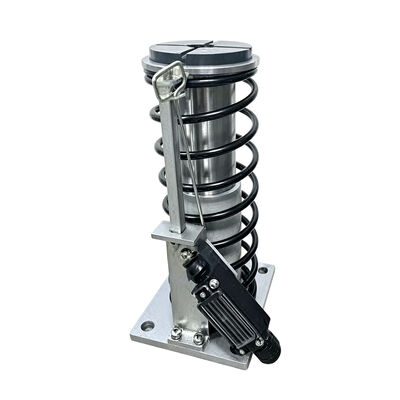
Premium elevator oil buffers are constructed from high-grade carbon steel or stainless steel housings, featuring fully sealed structures that prevent oil leakage and eliminate the need for on-site refueling . Many models incorporate internal spring mechanisms that ensure full re-extension within 90 seconds after compression . Advanced designs achieve IP67 ingress protection ratings, making them resistant to dust ingress and capable of functioning even when submerged in water up to 1 meter deep for 30 minutes . This durability ensures reliable long-term performance in diverse installation environments, from humid coastal regions to dusty industrial settings.
Industry Standards and Certification
To ensure passenger safety, elevator oil buffers must undergo type testing before market release . Accredited testing facilities conduct drop tests using masses at both the minimum and maximum ends of the specified load range. Tests are performed at temperatures between 0°C and 25°C, with displacement, velocity, and acceleration measured at sample rates of at least 100 Hz . Compliance with CE, GB, CSA, and ISO certifications confirms adherence to global quality benchmarks . Additionally, many buffers are fitted with position switches that detect full extension status—if the switch does not confirm that the buffer is ready for impact, the entire elevator system shuts down as a safety precaution .
Conclusion
The elevator oil buffer represents a sophisticated integration of hydraulic engineering, materials science, and safety system design. As elevator speeds continue to increase and building heights reach new extremes, the demands on oil buffer performance grow accordingly. Investing in high-quality, certified oil buffers is not merely a regulatory requirement—it is an essential commitment to passenger safety, equipment protection, and long-term operational reliability.

FAQ
1. Are the elevator wire ropes durable?
The elevator wire rope has special provisions and requirements. Configuration is not only for wire rope and rated load, but also considered the size of the traction, as a result, the tensile strength of wire rope is greater than the weight of the lift. The safety factor is equipped with more than four wire rope. So it won’t break at the same time.
2. Is it dangerous for power failure suddenly during the elevator running?
If it occurs, the elevator will automatically stop due to the electrical and mechanical safety device. In case of power failure,elevator brakes will automatically taken. In addition, the power supply departments such as planned outage, prior notice are also operating.
3. Will us be hurt when it closed suddenly?
In the closing process, if people touch the hall door, the door of elevator will automatically restart without any danger. With anti clamping switch, once the gate touched, this switching action make the elevator unable to be closed and even reopened. In addition, closing force is also available here.
4. How the elevator running?
Elevators are operated with a counterweight wire rope through the (tractor) traction drive, making ups and downs on the guide rail.
5. Is the escalator installation complicated?
We believe the functions of an escalator are not necessarily proportional to the operation complexity. Therefore, escalators designed by us apply an integrated structure, so that the equipment is more precise and more efficient and allows easier and more convenient commissioning.
6. Do you have any cerifications?
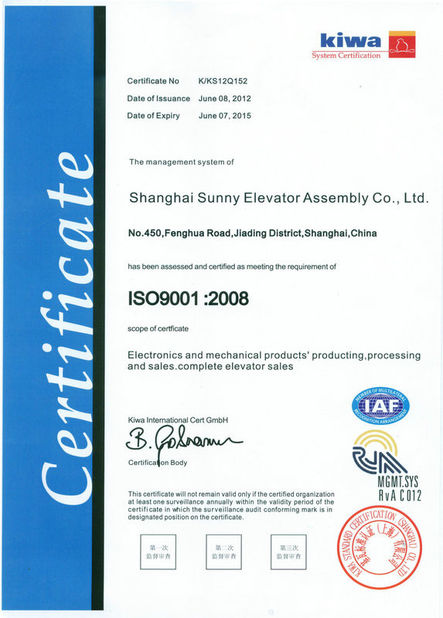
Yes, we do with ISO9001 / CCC / CE Certificates for u.


 ¡Su mensaje debe tener entre 20 y 3.000 caracteres!
 Spanish




Calificación General
Instantánea de calificación
La siguiente es la distribución de todas las calificacionesTodas las reseñas